


 01473 824212
Unearthing the History Behind Some of Our Designs
Having worked with numerous heritage organisations over the years we have completed designs for a range of historic buildings and landmarks. As part of the design process we find that it is a good idea to get to know a little bit about the building we are painting. A lot of castles can have quite a colourfully dark past and a lot of stately homes will have some sort of royal connection. The feel that we get from reading up on the history of these buildings we then try to incorporate into our designs.
Today I thought we could have a look at 3 of our heritage tea towel designs and try and learn a little more about the subject in question!
Dover Castle – The Key to England
Dover Castle is the largest castle in England and is listed as a scheduled monument. Due to the highly significant defensive role of the castle and its fantastic position it has long been known as ‘the key to England’. It is thought that there was some kind of structure on the castle site as far back as the Iron Age due to certain Iron Age relics found during excavation. After the invasion, the Romans built two Pharoses (lighthouses) at opposite ends of the town of Dover. One was on the castle site 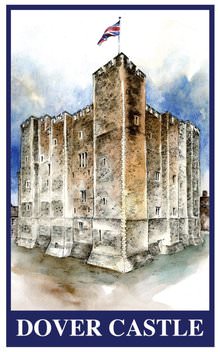 and is still standing today. Is thought that the Anglo Saxons then built a motte and bailey castle on the site. This was later attacked and burnt by the Normans after their victory at the battle of Hastings. Strangely, yet perhaps due to its excellent coastal position, William the Conqueror then paid for repairs to be made and fortifications to be added to the ashen building. This brings us to the period which really concerns us – The Great Tower. Built at the bidding of the powerful English King Henry II, the tower was a statement of Henrys power and ambition. It contains numerous rooms, including a magnificent throne room, the Kings bedchamber, kitchens and a great guest hall for entertaining. The tower is the main feature of our Dover Castle tea towel design. The castle is probably most famous for its underground tunnels built during the Napoleonic wars. These were the only underground barracks that were ever built in Britain. During the First World War the tunnels were converted into a military command centre and telephone exchange which the navy used to communicate with its ships.
Woolsthorpe Manor – The Birthplace of one of Britain’s best Brains
On 25th December 1642 Woolsthorpe Manor first heard the cries of a new-born. That new-born was Sir Isaac Newton. Newton’s father was a wealthy famer who died just months before his son came into the world. The farmstead house took its name from the roman word ‘thorpe’ meaning farm and the use of ‘wool’ at the start was simply a reference to the fact that sheep rearing was the principle activity there at that time. His mother tried to convince the teenage Isaac to leave school and make a living of farming at Woolsthrope. Luckily Isaac was not so compliant and wanted to finish his education. After studying at Cambridge for a number of years, Isaac returned to Woolsthorpe when the university was forced to close because of the plague. He spent two years at the manor developing theories he had started working on at Cambridge. The Woolsthrope garden is said to have been the stage of the famous Apple incident which inspired his theory on gravity. That is the tree that can be seen in our tea towel design to the left. Newton spent most of his middle to late life living in London before retiring to his sister’s house in Winchester.
Boscobel House – The Great Escape
Boscobel House in Shropshire is famous for its role in the escape of the fugitive King, Charles II. In the 1600’s the house was in the hands of a catholic family who refused to attend Anglican Church services. This got them into all sorts of trouble but in spite of this the house became a safe haven for catholic priests who were under persecution. The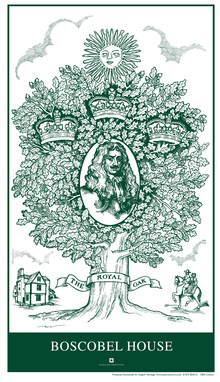 house has a number of ‘priestholes’ which served as hiding places if the Priest Hunters of the day came calling. In 1651 King Charles II became a man with a price on head his after the royalists lost at the Battle of Worcester. When Charles went missing, cavalry patrols were sent out in search of him. One of Charles' allies, Charles Gifford was nephew to Boscobel’s proprietor Frances Cotton. He led Charles to the house where he was disguised as a common woodsman. It is said that Charles hid in an oak tree on the Boscobel estate in order to escape detection by the roundheads. This tree became known as the Royal Oak. After a close shave when a cavalry officer walked directly under the Oak, Charles was moved to Moseley Old Hall. After 6 weeks on the run Charles finally made it to France.
As well as the three above, we have also been commissioned to create textile designs for historic attractions such as Stone Henge, Lindisfarne Castle and Kingston Lacy House to name but a few! To see more from our heritage & retail portfolio click here.
 01473 824212